rugby 4 rookies
Basic Laws & How to play

the aim of the game
Rugby is a contact sport played by two teams of 15 players. Each team is made up of eight forwards and seven backs, all with different roles to play on the pitch (if you want to learn more about who does what, our position guide is a great place to start).
At senior level, a match lasts 80 minutes, split into two 40-minute halves. The aim of the game is simple: score more points than the other team. You can do that in four different ways; by scoring a try or by kicking a conversion, penalty, or drop goal.
How the points work
Try: 5 points
A try is scored when a player places the ball down between the try line and dead ball line. A try is one of the best ways to score points as not only do you get 5 immediately, you also get the chance to take a conversion for an additional 2 points.
Conversion: 2 points
A conversion happens straight after a try and is worth 2 points. A player from the try scoring team will take a kick at goal from directly in line with where the try was scored. The two points are scored if the ball goes over the crossbar and through the two upright posts.
Penalty Goal: 3 points
Whenever a team is awarded a penalty because the opposition has broken a law, the team has the option to take a penalty kick at goal from the spot the penalty offence occurred. A penalty goal is worth three points and like a conversion the points are scored if the ball goes over the crossbar and through the two upright posts.
Drop Goal: 3 points
Like a penalty goal, a drop goal is also worth three points. A drop goal can be scored at anytime. For a drop goal to be scored a player must drop the ball, allow it to bounce and then kick it directly over the cross bar and through the two upright posts.
the pitch
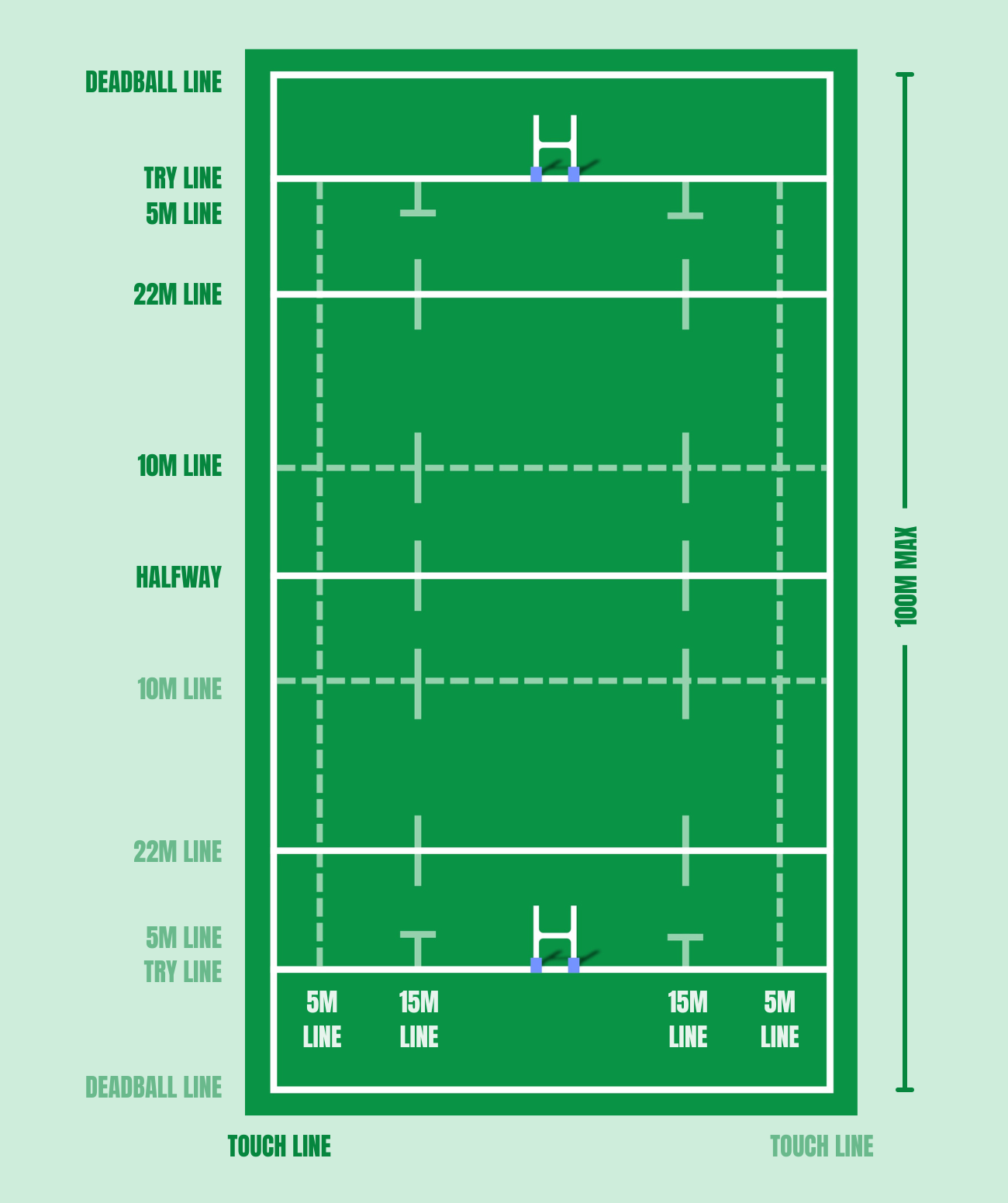
Rugby is played on grass, 4G, or hybrid pitches, all split into two halves by the halfway line, with the 10m and 22m lines marking key areas of the field.
At each end is the try line, where tries are scored. Behind it sits the dead-ball line - if the ball crosses it, play stops. Along the sides are the touchlines, which also mark the edge of play.
You’ll also see 5m and 15m lines running lengthways, mainly used to set up lineouts.
A full-size pitch can be up to 100m long and 70m wide.
Basic Laws of the game
Rugby Union has a lot of laws! We won’t bombard you with all of them at once, but here are the most fundamental ones:

the ball
➡️ You’re only allowed to pass the ball backwards
➡️ If the ball is passed forward or dropped forward (knock on) the game will restart with a scrum
➡️ If the ball leaves the field of play the game will restart with a lineout
➡️ You’re not allowed to handle the ball when you’re on the floor

the tackle
➡️ You can’t tackle above the shoulder in senior elite rugby or above the nipple line in junior and grassroots rugby
➡️ If a tackle occurs and the players go to ground it then becomes a ruck
➡️ If a tackle occurs and the players stay on their feet it then becomes a maul
➡️ When tackling you must wrap your arms (no shoulder charges)
➡️ You’re not allowed to tackle anyone when you’re on the floor

the kick
If a player on your team kicks the ball you can’t chase it unless:
➡️ You’re behind the player who kicked the ball
or
➡️ Another player who was behind the kicker runs past you
FAQs
-
At senior level each match lasts for 80 minutes (two 40 minute halves) but at junior and age grade levels the match length is shorter, depending on the age of the players.
-
Of the 15 starting players, each team has eight forwards and seven backs.
The forwards are involved in set piece (line outs and mauls) and provide a platform for the backs to play off. They are often (but not always!) bigger and stronger, whilst the backs are usually quicker with great agility and footwork.
For more info on the different rugby positions check out our position guide.
-
As well as the 15 starting players a match day squad can have anywhere up to 8 substitutes.
These players are usually referred to as ‘subs’ or ‘the bench’ but are sometimes called ‘impact players’.
The number of substitutes and how many times they can swap with players on the pitch depends on the level of rugby and league you’re playing in.
-
There’s lots of different rugby terms and phrases, but you’re not expected to learn it all at once, don’t worry!
If you hear or see something you don’t understand you can always look it up in our Rugby Dictionary.
It’s packed with loads of rugby terminology, common commentary phrases, and the kind of things you’ll hear said at training or during games.
Just click on a letter at the top of the page to jump straight to the terms you need.